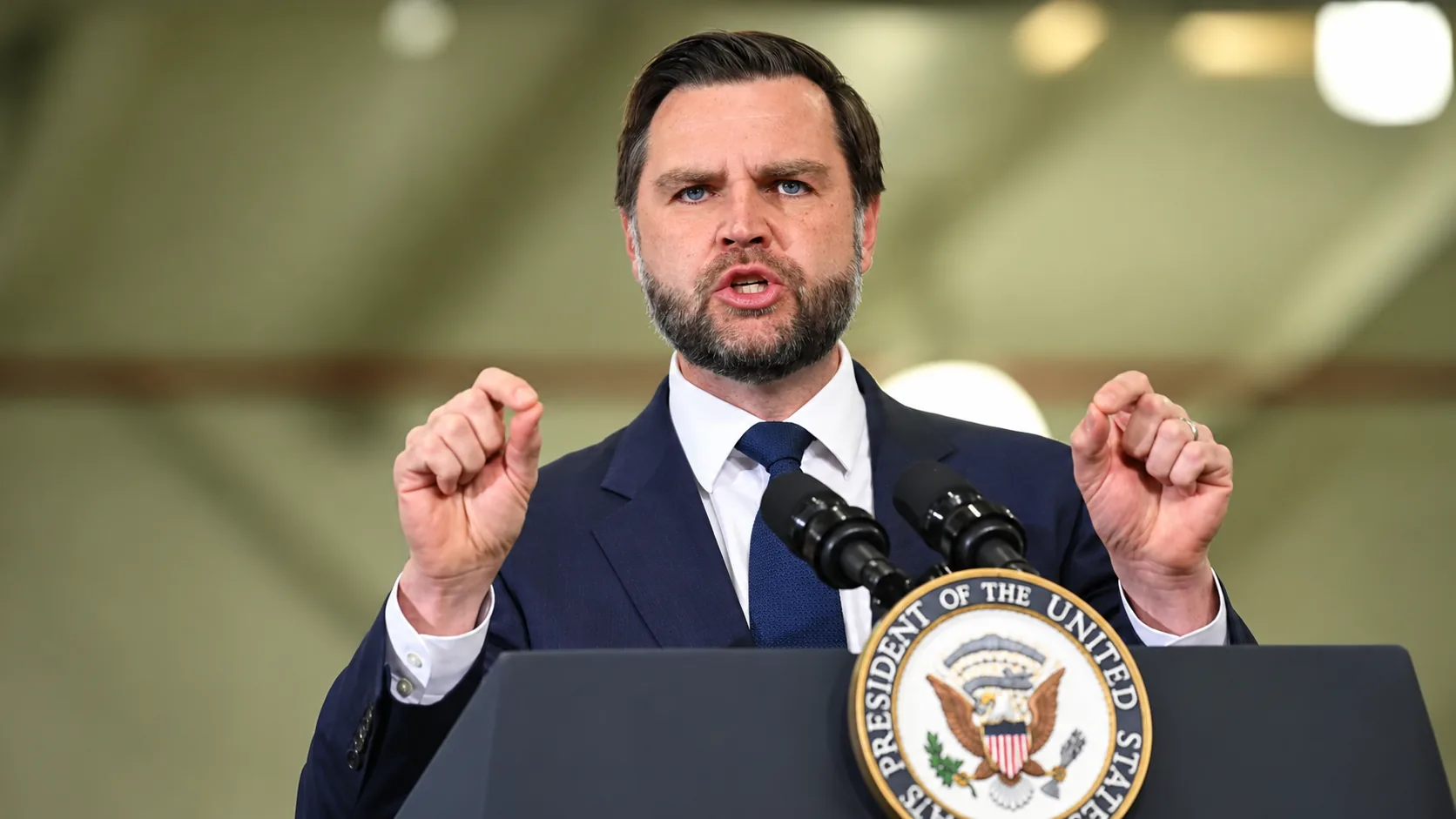
WASHINGTON (AP) — President Donald Trump directed Vice President JD Vance on Thursday to turn his attention away from the Iran war and concentrate instead on combating what the president describes as corruption and crime in cities and states controlled by Democrats.
Vance, who previously led negotiations aimed at securing a temporary ceasefire in the eight-month conflict, has been outspoken about the political consequences of the war. He has blamed the fighting and its economic impact for Republicans’ sweeping defeats in last week’s U.S. midterm elections.
However, Trump used a social media post Thursday to tell his vice president to redirect his efforts toward domestic issues, which he considers more urgent and politically important following the Republican losses.
“We don’t need a deal with Iran,” Trump wrote. “Those days have long since passed. We’ve got their money, Hundreds of Billions of Dollars, and we’ve got their Strait!”
Earlier this week, Trump said the war was “militarily is effectively over.” His latest comments appeared to reinforce that position as he instructed Vance to devote “complete and total attention” to his anti-fraud campaign.
Democrats have promised extensive investigations into Trump’s business activities and other matters after taking control of Congress in January. Corruption was among the leading concerns identified by voters, and Trump’s comments about Vance and Iran came partly in response to reports about the Democrats’ plans for congressional oversight.
The president’s statement also followed a Wall Street Journal report Wednesday evening suggesting that Vance was considering another round of direct discussions with a senior Iranian official.
The vice president’s office did not respond to a request for comment.
In an email responding to questions, the White House press office pointed to Trump’s social media statement, emphasizing that the president sees no reason to negotiate with Iran.
Vance Blamed Trump’s Iran War for Midterm Losses
Vance had long supported a more restrained approach to American military involvement overseas. After Trump launched the conflict with Iran, however, the vice president offered only limited public support for the war.
He later became the administration’s leading representative in an unsuccessful effort to negotiate an end to the fighting, heading discussions during the summer.
Following the Republican defeats on November 3, Vance published an extensive statement on X in which he openly addressed the political consequences of the conflict.
“If you’d like to argue it was worth it, that losing the Senate for the next 6 years was worth it, then do so,” Vance wrote. “Argue it was a worthwhile cost to pay. Agree or disagree, that’s at least honest.”
The vice president is also considering a possible presidential campaign in 2028. Public dissatisfaction with Trump’s handling of the Iran conflict could become a challenge for those political ambitions.
Trump has not yet endorsed a potential successor for the next presidential election. During an interview with CBS’s “60 Minutes” that aired Sunday, he said he “may or may not get involved” in making an endorsement.
Earlier this week, Trump expressed confidence that mediation efforts led by Qatar were progressing. He also suggested that he might not need to follow through on previous threats to resume large-scale bombardments of Iran now that the midterm elections had passed.
However, the president maintained that military action remained an option.
Speaking Thursday on “The Hugh Hewitt Show,” Trump said he was prepared to restart attacks if negotiations failed.
“If something doesn’t work out, I would not hesitate,” he said.
In a separate interview with commentator Stephen A. Smith, Trump suggested that he had not ruled out strikes against Iran’s Pickaxe Mountain facility, which is linked to the country’s nuclear program. He indicated that the United States could consider an attack if it detected signs of activity at the site.
Waters Around Iran Remain Treacherous
Oil shipments passing through the Strait of Hormuz have returned to levels close to those recorded before the war. Iran had effectively restricted traffic through the strategically important waterway for months, disrupting the movement of crude oil and other energy supplies from neighboring Persian Gulf countries.
However, international oil tankers are now relying on escorts from the U.S. Navy to navigate the strait.
The American military has also conducted limited strikes against Iranian targets in recent weeks, including attacks on the country’s air defense systems.
Although crude oil and liquefied natural gas exports from the Gulf are increasing, attacks against vessels attempting to cross the region’s contested waters have also become more frequent.
On Thursday, the British military reported that at least two tankers had been struck by projectiles in recent days.
The United Kingdom Maritime Trade Operations Center, which monitors maritime security, said one vessel was hit on Wednesday in the Strait of Hormuz, northwest of Ras al-Khaimah. Its crew evacuated safely, and no casualties were reported.
In a separate incident on Tuesday, another tanker was struck by a projectile in the Persian Gulf. Several people were taken ashore for medical assistance, while the remaining crew members were reported safe and accounted for.
Secretary of State Marco Rubio said earlier this week that he had urged his counterparts in the Group of Seven to increase their efforts to protect commercial shipping from Iranian attacks during discussions in Paris.
However, he acknowledged that the talks had produced no progress on the issue.
Meanwhile, a Saudi-led coalition remains involved in fighting against Iranian-backed Houthi rebels in Yemen.
The conflict has created additional risks for commercial shipping through the Bab el-Mandeb Strait, an important passage connecting the Red Sea with the Gulf of Aden and the Indian Ocean.
The continued instability in these waterways has raised concerns about the safety of international shipping and the transportation of energy supplies.
Qalibaf Claims the U.S. Wants Russia to Intervene
Meanwhile, Iran’s chief negotiator and parliament speaker, Mohammad Bagher Qalibaf, claimed in an interview that the United States had approached Russian President Vladimir Putin and asked him to help arrange direct negotiations between Washington and Tehran.
“It was the Americans who, during a visit to Moscow, spoke with Mr. Putin and asked him to speak with Iran so that, in any case, Iran would agree to speak directly with them,” Qalibaf told Al Jazeera.
He also described the relationship between Iran and Russia as close and strategically important.
“Look, Russia and Mr. Putin, the Russian president, are friends of ours. We have strategic relations with Russia. We are very close, and we hold Mr. Putin in particularly high regard,” he said.
The White House did not directly answer a question about whether the United States had asked Putin to facilitate negotiations with Iran.
Qalibaf also said that the secretary of Iran’s Supreme National Security Council, Maj. Gen. Mohsen Rezaei, had traveled to Russia and briefed Putin on developments in the negotiations.
According to Qalibaf, Rezaei informed the Russian president that Iran had communicated its position to the United States, including what Tehran considers the legitimate rights and demands of its people.
He said the next move was now up to Washington.
“It is up to them to decide. If they are truly telling the truth and are sincere about negotiations, then they should respond and begin the process,” Qalibaf said.
“But if they want to pursue the path of war, then naturally, we are fully prepared for that as well.”