The Phone on the Kitchen Wall
For forty years, Walter had kept his daughter’s bedroom exactly as she had left it, even preserving the quilt decorated with faded daisies.
The sheriff had told him that his wife and two children had been swept away by a river in 1985. But one afternoon, while packing up the old bedroom, Walter’s knees suddenly gave way. He fell onto the mattress, and something beneath it snapped.
Hidden inside was a green biscuit tin sewn into the mattress.
The first line of the letter inside was written in his wife’s familiar handwriting:
“Do not trust Joanne.”
Walter folded the letter and stood up without reaching for his cane.
The Phone on the Kitchen Wall
“Walter, where on earth is Rachel?”
The telephone on the kitchen wall rang at 9:14 on a Sunday night. That alone was unusual. Nobody called the Hale family after nine unless something had gone wrong at the print shop.
“What do you mean, Joanne?” Walter asked, wrapping the phone cord twice around his wrist, just as his daughter Rachel used to tease him about. “She’s with you. They’ve been with you since Friday.”
There was a long silence.
“They never arrived,” Joanne replied. “I thought you’d all decided to stay home. I thought you’d talked her out of the trip because of your ballots.”
Walter felt his stomach tighten.
He had stayed behind that weekend to finish printing fourteen thousand county election ballots. Every sheet had to be ready, cut and packed for the courthouse by Monday morning.
“They left Friday morning,” he said. “Before seven. I watched them drive away.”
He could barely remember putting the telephone down. The receiver swung against the kitchen cabinet, knocking softly over and over.
He remembered that Friday morning, September 20, 1985, as clearly as if it had happened yesterday.
Rachel was kneeling in the hallway, tying their daughter Abigail’s sneakers in her usual double knot. Their son Lucas was hopping around on one foot, trying to make his sister laugh.
“Are you sure you won’t come, Walter?” Rachel asked. “It’s only one weekend. The ballots will still be there Saturday night.”
“Rach, I’ve already explained,” he replied, sounding harsher than he intended. “If those ballots aren’t finished, Hollis will make my life miserable. We’ve got the mortgage and the wagon’s brakes to worry about.”
Rachel finished tying Abigail’s shoes and stood up. She looked at him for a moment, then kissed him goodbye.
Her cheek was warm from the sunlight coming through the screen door.
Abigail hurried outside and climbed into the family’s green Ford station wagon. She leaned out of the window and waved excitedly.
“Don’t worry, Daddy! Lucas and I will collect the prettiest smooth seashells for your wooden desk!”
Walter smiled. There was an empty corner on his oak desk that Abigail had been planning to decorate with seashells since July.
“You two listen to your mother on the highway,” he reminded them.
Lucas grinned, showing the two missing teeth at the bottom of his mouth.
“We’ll be on our very best behavior, Dad!”
Rachel backed down the gravel driveway and turned toward the state road leading to Cape Larkin. Her sister Joanne lived there in a small gray cottage near the beach.
Walter watched the green station wagon disappear between the pine trees.
It was the last time he saw his wife and children.
After Joanne’s telephone call, Walter contacted the Pender County Sheriff’s Office. By midnight, deputies were sitting in his kitchen, drinking coffee from Rachel’s favorite mugs.
Within days, the search had expanded across three counties.
Then, on Wednesday afternoon, a game warden discovered the green station wagon on an old timber bridge over Blackwood Creek, eleven miles away from the route Rachel should have taken.
Sheriff Cooper personally drove Walter to the scene.
“The driver’s door was unlocked,” the sheriff explained. “The keys were still in the ignition. Your wife’s purse was on the front seat, with her wallet and forty-two dollars inside.”
Walter grabbed the sheriff’s jacket.
“Where are my children? Sheriff, where are my kids?”
The sheriff placed a hand on his shoulder.
“That creek runs hard this time of year, Walter. After Thursday’s rain, it’s stronger than I’ve seen in years.”
Divers searched Blackwood Creek for nineteen days. They recovered old tires, a bicycle frame, a mailbox and pieces of rotten timber.
But they never found a single belonging that could be connected to Walter’s family.
Investigators eventually settled on the theory that Rachel had stopped on the bridge, perhaps because of the children or trouble with the wagon’s brakes. Someone had slipped, another person had gone into the water trying to help, and the current had carried all three away.
Joanne remained in Millbrook for nearly a month. She prepared meals Walter barely touched and sat beside him at the kitchen table.
Every evening, she gently repeated the same words.
“Walter, you have to accept the river.”
Eventually, she returned to the coast. Her telephone calls became less frequent, and by 1988, the number at her cottage had been disconnected.
In the fall of 1987, the district court officially declared Rachel, Abigail and Lucas dead.
Walter placed the certificates in his desk drawer, beneath the empty corner where Abigail’s seashells were supposed to go.
Life continued, but Walter never truly moved forward.
He worked at the print shop, eventually became foreman and retired. He paid off his mortgage in 2001, celebrating the occasion with a simple can of soup.
But he never touched his children’s bedrooms.
Lucas’s dinosaur sheets remained on his bed. Abigail’s daisy quilt stayed folded down at one corner, exactly how she liked it.
One spring, his neighbor Henry suggested that he finally pack away the children’s belongings.
“You can’t keep living beside a museum, Walt,” Henry told him.
“I can’t do it, Henry,” Walter replied. “Some foolish part of me still listens for them coming down the stairs.”
Henry understood enough not to ask again.
Every September 20, Walter drove to Blackwood Bridge and stood there for an hour with a thermos of coffee.
He did this for thirty-nine consecutive years.
There was only one occasion when something unusual happened after his visit, although he didn’t understand its significance at the time.
In 2003, he returned home one evening to find the faint smell of lavender in the house. It was the same soap Rachel used to buy from the drugstore on Elm Street.
When he entered Abigail’s bedroom, he noticed that the corner of her quilt had been folded in the opposite direction.
He assumed grief was playing tricks on his memory.
He went to bed, but sleep never came easily that night.
The Green Biscuit Tin
Forty years of carrying grief had taken a toll on Walter.
That March, at seventy-four, he suffered what his doctor described as a minor stroke. His left leg suddenly weakened while he was shopping at a hardware store, and he spent four days at Millbrook Regional.
During a follow-up appointment, Dr. Evans warned him that continuing to live alone was becoming dangerous.
“You can’t keep managing that house by yourself, Walter,” the doctor said. “Your blood pressure is high, you’ve got stairs, and nobody is there to check on you.”
Walter insisted he had managed for forty years.
But his doctor reminded him that he had managed with two healthy legs.
The following weekend, Walter’s nephew Patrick arrived from Wake Forest. Patrick was the son of Walter’s late brother Ray.
He and his wife Dana offered Walter a place in their guest cottage. It was a single-story building with a ramp, and they would be able to check on him every day.
Walter knew what accepting their offer meant.
He would have to sell the old house and finally pack away his family’s belongings.
Patrick promised to help with everything.
They arranged the move for the last Sunday in April.
By Sunday afternoon, most of the house had been packed. Only Abigail’s bedroom remained untouched.
Walter asked Patrick to let him handle that room alone.
He picked up her little music box, the stuffed rabbit with one flattened ear and the glass jar of marbles she used to shake for fun.
His legs had been trembling all afternoon.
Then, while moving between the closet and the window, his knees suddenly gave way.
He fell backward onto Abigail’s bed.
The mattress snapped beneath him.
It wasn’t the ordinary creaking of old springs. It was a sharp crack, as if something inside had broken.
Walter pressed his palm against the quilt. Beneath the stuffing, he felt something solid with square edges.
He slowly pushed himself upright and examined the mattress.
Something was hidden inside.
He called Patrick but stopped before raising his voice. For reasons he couldn’t explain, he wanted to discover what was inside before anyone else entered the room.
Using his cane, he reached the hallway closet and retrieved Rachel’s old sewing basket.
Inside were her heavy tailor’s scissors.
Back in the bedroom, he turned the mattress onto its side. Its blue fabric was faded almost gray, but something immediately caught his attention.
A seam ran across the middle.
It was made with thick white thread and carefully sewn by hand.
Walter knew those stitches.
Rachel had made them.
He cut through the thread and pulled the fabric apart. Beneath the cotton padding, his fingers touched something cold.
He pulled it out.
It was a square green biscuit tin with a gold rim and an old Scottish shortbread label. The lid had cracked slightly when he fell onto the mattress, and several layers of yellowed tape covered its edges.
Walter recognized it immediately.
Rachel used to buy those biscuits every Christmas. Afterward, she kept buttons inside the empty tin.
His hands trembled as he removed the tape.
Inside were a folded sheet of notebook paper, several photographs and a small object wrapped in tissue.
He opened the tissue first.
A smooth, pale seashell rested in his palm.
Written on its inside were four words in faded purple marker:
FOR DADDYS DESK.
The handwriting belonged to Abigail.
Walter couldn’t move.
She had always forgotten the apostrophe, and her second-grade teacher used to correct it in red ink.
“Uncle Walt?” Patrick called from outside. “Everything okay?”
“Fine,” Walter answered, struggling to keep his voice steady. “Just taking a little break.”
He placed the shell on the windowsill and unfolded the letter.
The handwriting was unmistakably Rachel’s.
At the top was a date.
September 20, 2003.
Walter read it several times.
That was the same year he had smelled lavender in the house and discovered Abigail’s quilt folded differently.
He began reading.
“Walter, if your hands are holding this note, then something terrible has caught up with me, and you must read every single sentence with the utmost care.”
He paused, gripping the edge of the mattress.
Then he continued.
“Do not trust Joanne under any circumstance, my love, because there is an immense secret about my life that you were never told.”
Joanne.
Walter stared at the name.
How could he not trust her? She had spent weeks comforting him after the disappearance. She had sat beside him, cooked for him and encouraged him to accept that the river had taken his family.
But Rachel’s warning was unmistakable.
As he read further, old memories began returning.
Rachel and Joanne had never looked much alike. Rachel was small, with chestnut hair and a gentle voice. Joanne was almost six feet tall, dark-haired and sharp-featured.
Rachel had once explained that they had different fathers.
Joanne always called her “Rae,” a name nobody else used.
Rachel never liked being called that by Walter.
She had also claimed that all her childhood photographs were destroyed in a fire when she was sixteen.
There had been other strange moments, too.
She always preferred sitting facing the door in restaurants. She checked the rearview mirror repeatedly while driving. Once, when a man in a brown suit entered a restaurant, she suddenly picked up Lucas and left without finishing her meal.
Walter had never questioned any of it.
Now, sitting in his daughter’s bedroom, he began wondering how much he had failed to understand.
Then he reached the next paragraph.
“Joanne was never my biological sister, Walter, but rather my commanding handler from a federal intelligence unit based in St. Louis.”
Walter read the sentence again.
And again.
The woman he had known as Rachel’s sister had apparently been something entirely different.
Outside, Patrick continued preparing for the move, unaware that the past was beginning to unravel inside the old bedroom.
Walter turned the page.
One sentence had been pressed so hard into the paper that the pen had nearly torn through it.
“They gave me a choice, Walter. And I need you to know that I chose you.”
What Rachel Chose
Walter forced himself to continue reading.
Rachel began by reminding him of their first meeting in Cincinnati in April 1975.
He remembered the bookstore on Fourth Street. He had accidentally knocked over a table of discount atlases while reaching for a book about letterpress printing.
A young woman in a navy raincoat had helped him collect the fallen books.
He had complimented her steady hands and asked her to lunch before he even knew her name.
It had been one of the happiest afternoons of his life.
But Rachel’s letter revealed something he had never imagined.
“I was there under another name, Walter. By then, I had spent five years working for people whose names I still cannot write down. My job was to watch, listen, and report. That afternoon, I was supposed to be watching a man in the history section. Instead, I watched you apologize to a stack of maps.”
Walter let out a broken laugh.
The woman he had fallen in love with had originally been watching someone else.
Rachel explained that after meeting him, she requested permission to leave her former life. It took almost a year before the arrangement was approved.
Joanne had organized her departure.
Rachel was allowed to begin a quiet new life with a different surname and a husband who worked with ink and paper. In return, she was expected never to reveal her past.
Joanne promised to keep an eye on her, supposedly like a sister.
Rachel believed she had finally escaped.
For nine years, she lived the ordinary life she had always wanted. She raised Abigail and Lucas, prepared meals, hemmed their clothes and spent Sunday evenings cutting coupons with Walter.
She thought her past was behind her.
Then, in August 1985, Joanne visited the house while Walter was working late.
Rachel reminded him of the two coffee cups he had noticed drying in the kitchen that evening.
There had been no Avon lady.
Joanne had come to deliver a warning.
An internal review of former intelligence operatives was underway. Someone higher up had decided Rachel knew too much to continue living openly with her family.
Walter, she was told, could become a risk because of what Rachel might eventually reveal to him.
According to the letter, Rachel was given two choices.
She could disappear with Abigail and Lucas, leaving behind an accident so convincing that nobody would search for them.
Or the people involved would make sure Walter could never become a problem.
Rachel understood the threat.
She wrote:
“They gave me a ruthless choice. I could disappear with Abigail and Lucas, with an accident staged so cleanly that no one would ever look for us. Or they would make sure you could never become a problem. Joanne didn’t say how. She didn’t need to. I had seen how these things were handled.”
Then came the sentence that changed everything.
“I chose the bridge, Walter. I chose to be dead to you so that you could go on living. I’m so sorry. I have been sorry every single day.”
Walter covered his eyes.
For forty years, he had blamed himself for not going on that family trip. He had believed that if he had driven the wagon himself, he might have prevented the tragedy.
Every September, he had stood on that bridge apologizing to the water.
Now he was learning that the water had never taken his family.
“They never drowned in that creek,” he whispered. “They never drowned.”
He continued reading.
Rachel explained that she had deliberately parked the station wagon on Blackwood Bridge before dawn. Joanne had told her that the creek would be swollen after the previous day’s rain.
She left her purse and forty-two dollars inside the car to make the disappearance appear convincing.
A vehicle was waiting near an old fire road on the northern side.
The children believed they were going on an adventure.
Abigail had asked whether Daddy would join them later.
Rachel told her yes.
She admitted that she had never forgiven herself for making that promise.
Joanne drove them to Virginia, then to several other locations. Within a year, they had new names and a small rented house in an unnamed town.
Joanne promised she would handle Walter and make sure he accepted the river.
Once Walter stopped asking questions, Joanne no longer needed to monitor him.
Rachel then revealed why she had hidden the letter.
On the eighteenth anniversary of their disappearance, she had returned to the old house.
She knew Walter would be visiting Blackwood Bridge, as he did every September 20.
An old contact had continued keeping track of him. Through that person, Rachel knew he had never sold the house, changed the locks or moved away.
She even knew that he still kept the spare key beneath Abigail’s painted clay frog near the back steps.
Rachel had entered the house and walked through the rooms.
She had stood in Walter’s den and looked at the empty corner of his desk.
Then she had sat on Abigail’s bed and sewn the green biscuit tin into the mattress.
She knew Walter would never allow anyone else to dismantle that bed.
The lavender smell was real.
The quilt had been moved by Rachel.
His wife had returned to the house while he was standing at the bridge, believing his family was lost forever.
Walter lowered the letter and stared at the photographs inside the tin.
Rachel had written that there was something else he needed to discover.
“Look at the photographs.”
Find Thomas
Walter slowly turned over the first photograph.
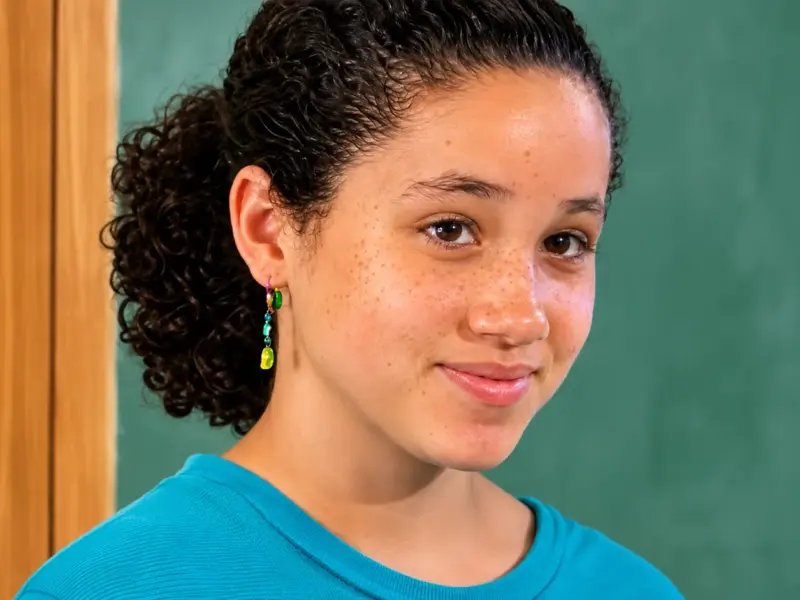
A young woman wearing a royal-blue graduation gown stood beneath a coastal pine tree. She had Rachel’s chestnut hair, her small chin and a familiar smile.
On the back, Rachel had written:
“June 1995. Eighteen. Valedictorian. She gave the speech about her father.”
Walter’s hands began shaking.
It was Abigail.
His little girl was no longer eight years old. She had grown into a young woman and graduated from school.
He turned over the second photograph.
A young man stood beside a blue pickup truck in front of a small woodworking shop. His sleeves were rolled up, and sawdust covered his jeans.
He had thick, curly brown hair.
Walter recognized that hair immediately.
It was Lucas.
His little boy had grown up, too.
On the back, Rachel had written:
“Spring 2003. Twenty-four. His own shop, all paid for. He builds tables.”
Walter placed the photographs side by side.
For forty years, he had remembered his children as a little girl with missing teeth and a curly-haired boy who never stayed still.
Now he was looking at the adults they had become.
There were more photographs inside the tin.
Abigail holding a fishing pole when she was twelve.
Lucas wearing a Little League uniform at ten.
Another photograph showed both children sitting around a birthday cake. They were teenagers, and the cake had a message written in blue icing:
HAPPY BIRTHDAY DAD.
There were no candles.
On the back, Rachel had written:
“Every March 9th. They insisted.”
March 9 was Walter’s birthday.
His children had celebrated it every year, even though he wasn’t there.
He carefully placed the photographs on the quilt and returned to the final paragraph of Rachel’s letter.
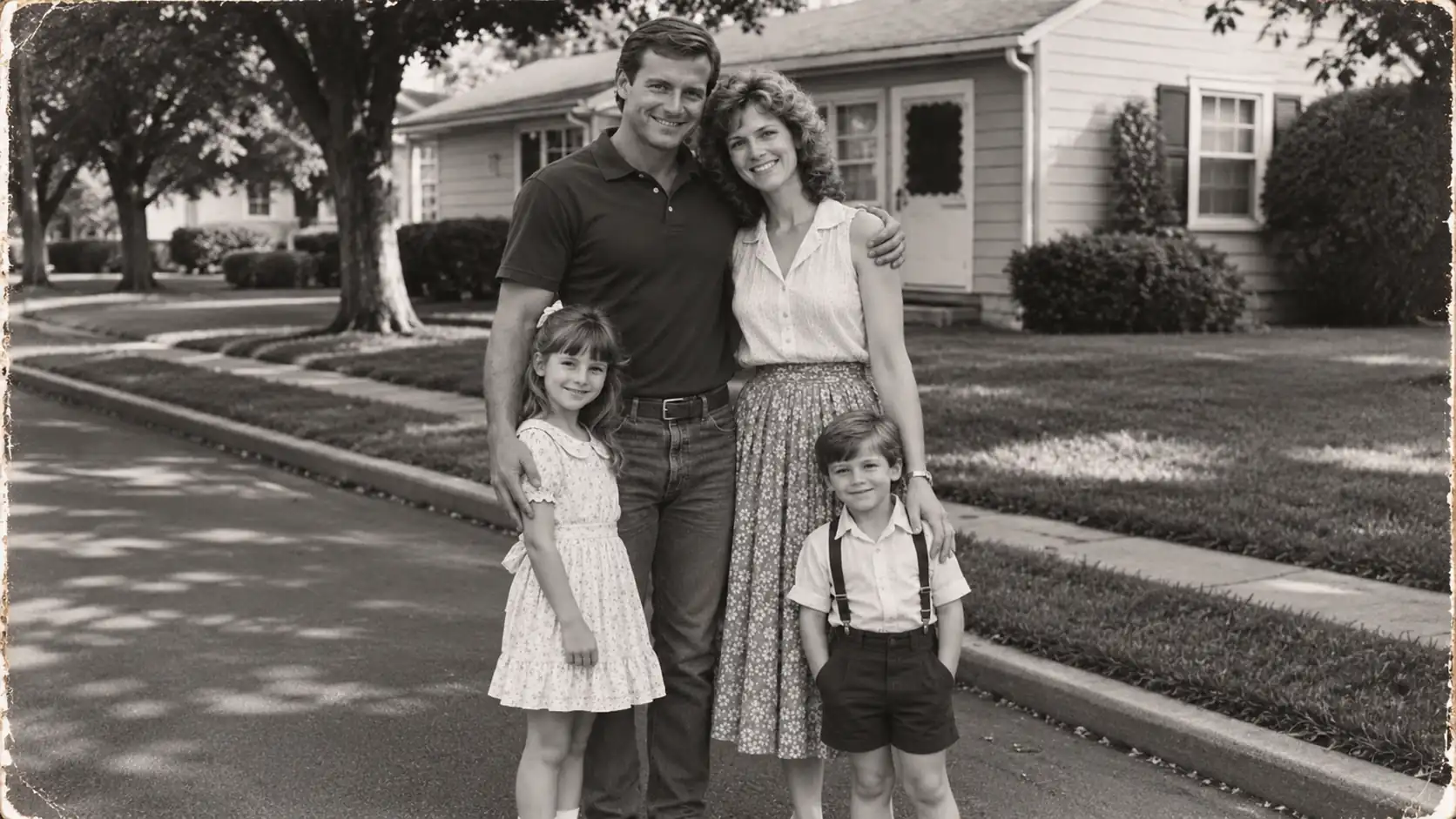
She explained that their children had grown up seeing copies of their family portrait. They constantly asked questions about their father and wanted to hear stories about him.
Rachel told them Walter was a good man who had stayed behind to keep them safe.
She never revealed the full truth because she feared the consequences.
Their son had taken the name Thomas and established his own carpentry business in Oak Ridge, a town in the hills of western Pennsylvania.
Abigail moved frequently, but Thomas knew how to find her.
Rachel’s final instruction was simple.
“Find Thomas, my darling Walter, and show him this tin so that he finally knows the whole truth about why his father had to stay behind.”
At the bottom of the letter, she had added one more message.
“Abigail made me promise I’d bring you the shell. She found it the summer she turned nine. She’s kept it for you ever since. — R.”
Walter looked at the windowsill.
The small seashell rested in the afternoon sunlight.
Abigail had found it a year after the disappearance and kept it through all those years of moving, changing names and starting over.
She had never forgotten her promise to her father.
Walter sat quietly, overwhelmed by everything he had learned.
He felt anger toward Joanne and the people who had forced his family to disappear. But he also felt something more complicated toward Rachel.
He loved her. He understood that she had been trying to protect him.
Still, he wondered why she had never found a safer way to contact him.
Why had she allowed him to spend forty years believing his children were dead?
He had no answer.
But he knew one thing.
Rachel had never stopped loving him.
There was a knock at the bedroom door.
“Uncle Walt?”
Patrick appeared in the doorway. He had been waiting for nearly an hour.
“You holding up all right in here?”
Walter quickly gathered the letter and photographs and slipped them into the inside pocket of his cardigan.
He would tell Patrick eventually, but first he needed to find Thomas.
“I’m doing much better than all right, Patrick,” he replied.
Patrick looked at the damaged mattress, the scissors and the pieces of yellowed tape scattered across the floor.
“The moving van is coming at six,” he reminded him. “Dana has prepared the cottage and made up your bed with that blue blanket you like.”
Walter thanked him.
Then Patrick asked whether he should collect the rest of Abigail’s belongings.
Walter reached for the seashell, wrapped it carefully in its tissue and placed it in his shirt pocket, directly over his heart.
“Everything except this,” he said.
For forty years, other people had made decisions about his family.
Someone had decided he was a risk. Joanne had instructed him to accept the river. Even the court had officially declared his wife and children dead.
But Rachel’s letter had given him something back.
The chance to make his own decision.
“Let’s finish loading the truck, Patrick,” Walter said. “Because you and I have a very important road trip to take tomorrow morning.”
Patrick looked surprised.
“Uncle Walt, Dr. Evans said you shouldn’t—”
“Dr. Evans said I shouldn’t be alone. So I won’t be. You’re driving.”
Walter pushed himself upright using the edge of Abigail’s bed.
His left knee complained, and his right leg trembled, but he managed to stand.
Patrick picked up the cane and offered it to him.
Walter accepted it, but tucked it beneath his arm rather than leaning on it.
Then he walked into the hallway on his own two feet.
The old oak desk in the den was already wrapped in moving blankets. Its empty corner, where Abigail’s seashells had been promised for forty years, was waiting.
Tomorrow, Walter would travel north to a small town in Pennsylvania.
He would look for a hand-painted sign above a woodworking shop.
He would knock on the door.
And when a curly-haired man with his face answered, Walter would hold out the green biscuit tin.
Perhaps, if his legs held up and life gave him the chance, he would finally place that smooth, pale seashell on his desk.
Right where his little girl had always promised it would go.
What would you say first if you were Walter and the son you had mourned for forty years suddenly opened that door?