Brain teasers are a great way to challenge your mind, and some of the simplest-looking puzzles can be surprisingly difficult. One riddle that has gained attention online is the famous “6 Eggs Riddle.” At first, it appears to be a straightforward math problem, but the real challenge is understanding the wording.
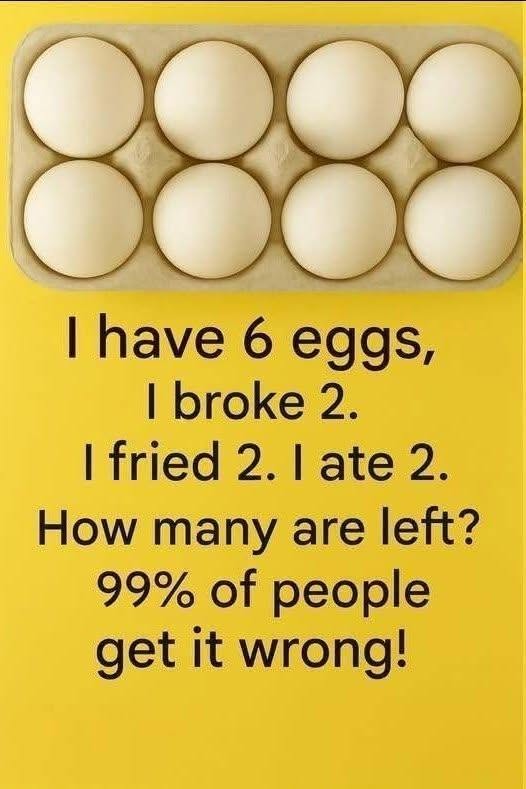
The riddle asks: “I have 6 eggs. I broke 2, fried 2, and ate 2. How many eggs are left?”
Many people immediately answer “zero,” assuming that three separate groups of two eggs were used. However, that interpretation misses the trick hidden in the question. The correct answer is 4 eggs.
Here is why.
You begin with six eggs. You take two of them and break them. Those same two eggs are then fried and eventually eaten. The riddle never says that you broke two eggs, fried two different eggs, and then ate another two.
Instead, the actions happen one after another to the same pair of eggs.
Think about what happens in an ordinary kitchen. You crack an egg, cook it, and then eat it. You would not need a new egg for every step. The same egg goes through the entire process.
Therefore, only two eggs have actually been used from the original six.
6 − 2 = 4
That leaves four untouched eggs.
The reason this puzzle confuses so many people is that our brains often focus on the numbers before considering the meaning of the sentence. Seeing “2,” “2,” and “2” can naturally make us think of three separate groups. But the wording connects all three actions together.
This simple riddle offers a useful lesson about logical thinking. Before doing any calculation, it is important to understand exactly what the question is saying. Sometimes the answer is not difficult at all—the challenge is avoiding an assumption that was never stated.
So, if someone asks you the 6 Eggs Riddle, remember not to rush. The eggs that were broken are the same eggs that were fried and eaten.
Final answer: 4 eggs are left.
Now you can challenge your friends with the same question and see whether they spot the trick!