Being part of the royal family can be demanding, but being a woman in the royal family comes with its own set of expectations. Even sitting down properly can require considerable effort. Royal women are generally expected to keep their knees and ankles together to avoid accidentally revealing too much when photographers capture them from a low angle. Although this position is not formally written into a royal rulebook, it is often preferred over crossing the legs at the knees.
Kate Middleton has occasionally been seen breaking royal conventions, but when it comes to this unwritten sitting protocol, she has mastered it. Royal watchers have even given her signature pose a name: the duchess slant.
Beaumont Etiquette introduced the term, and royal etiquette expert Myka Meier explained the technique to People in 2016. She said the pose works particularly well when a camera is positioned directly in front of someone. By slightly angling the knees to create a zigzag effect while wearing a dress or skirt, the legs appear at an angle that helps preserve modesty.
To achieve the look, a person must sit upright, keep the shoulders positioned forward, hold the knees and ankles together, and gently angle the knees to one side. It sounds simple, but maintaining the position throughout a long royal engagement could certainly be tiring.
Grant Harrold, a former butler to King Charles III, also explained to the Daily Mail, as reported by OK! Magazine, that this position can help prevent female royals from accidentally catching passersby with a foot sticking out when their legs are crossed at the knees.
So, while the duchess slant may require a little extra effort, it also serves a practical purpose. For Catherine, it has become a recognizable part of her polished public appearance.
Catherine’s Demeanor Has Inspired Another Flattering Phrase People Use to Describe Her
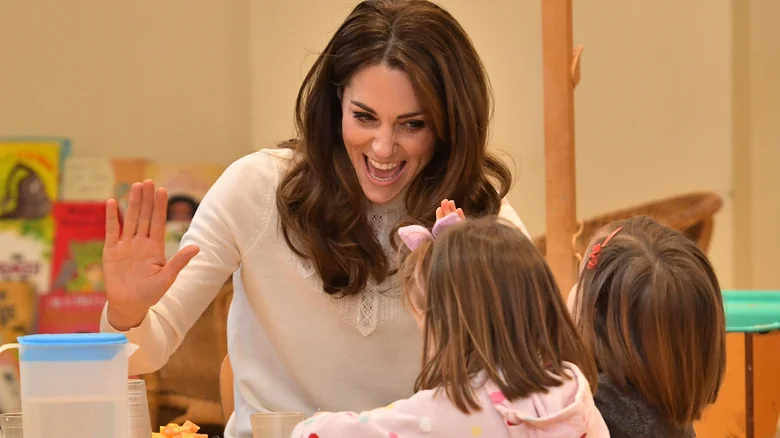
Princess Catherine is known not only for her elegant posture and carefully maintained appearance during royal engagements but also for her warm personality. Reports and public appearances suggest that she can be more relaxed away from formal royal settings, particularly when interacting with children.
In January 2020, Catherine visited LEYF Stockwell Gardens Nursery, where she helped serve breakfast to the children. Her interaction with the young pupils impressed royal fans, many of whom praised her kindness and affection. Some even began referring to her as the “children’s princess,” a nickname that recalls the affectionate title “People’s Princess,” famously associated with Princess Diana.
“She’s truly the children’s princess,” one fan wrote on Instagram. Another admirer praised Catherine as the children’s princess and the future queen.
Catherine demonstrated this approachable side again in February 2020, during an encounter with a three-year-old girl named Annabel. The little girl was excited about meeting a real-life princess, but she had a particular idea of what a princess should look like.
Despite Catherine’s reputation for wearing beautiful royal outfits, Annabel was disappointed by her appearance that day. She had expected something much closer to the glamorous dresses worn by Disney princesses.
Annabel’s mother later explained to the Daily Mail that she had warned Catherine about her daughter’s current Disney Princess phase. The young girl had developed clear expectations of how a real princess should dress.
Catherine responded with warmth and humor. Looking directly at Annabel, she reportedly said, “I’m really sorry I’m not wearing a pretty dress today.”
Annabel then explained her disappointment, saying, “I thought you’d look like Cinderella.”
The exchange offered a charming glimpse of Catherine’s ability to respond kindly to a child’s honest expectations. Rather than taking the comment personally, she played along with the little girl’s idea of a princess.
Moments like these help explain why some royal fans describe Catherine as the “children’s princess.” Her public image is associated with elegance and tradition, but her interactions with young children also reveal a more playful and approachable side.