Sometimes the most interesting discoveries are not enormous monuments or famous historical landmarks. Instead, they are small, overlooked objects that most people might pass without giving them a second glance.
Imagine walking along an old trail through a forest. Beneath your feet is a narrow path of dirt and gravel. Trees stretch overhead, fallen leaves gather in shallow grooves, and birds move quietly through the branches.
Then something unusual catches your attention.
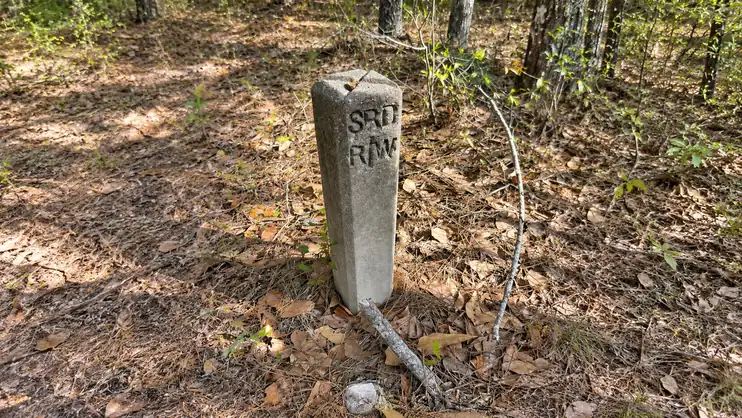
Just beyond the trail, partly surrounded by weeds and undergrowth, stands a small concrete post. It reaches roughly knee height and shows signs of years of exposure to rain and sunlight. At first, it looks like an ordinary block of concrete, perhaps with faded letters or markings on its surface.
But this simple object could hold an interesting piece of local history.
Posts like these can be remnants of State Road Department right-of-way markers. Although they may appear insignificant, they can tell a story about how roads once connected communities and influenced the surrounding landscape.
They are quiet reminders of transportation routes that existed long before nature gradually reclaimed the land.
The Quiet Thrill of Discovering Hidden History
For anyone who enjoys exploring abandoned railways, woodland trails, and forgotten backroads, finding something like this can be an exciting experience.
You might set out expecting nothing more than a peaceful walk through the woods. Then, without warning, you discover a small object that makes you look at the entire landscape differently.
Suddenly, that concrete post becomes more than an old piece of infrastructure.
It becomes a clue.
A reminder that something important once existed in that very location.
Hikers, explorers, and amateur historians often experience this change in perspective when they come across forgotten structures. The forest no longer appears to be simply a collection of trees and natural features. Instead, it begins revealing traces of the people and activities that once shaped it.
Old infrastructure does not always disappear completely. Even after many decades, small signs of human activity can remain hidden in the landscape.
A raised strip of ground that looks unusually straight.
A shallow depression with a smooth surface.
Small pieces of gravel buried beneath the soil.
And sometimes, a solitary concrete marker standing quietly beside a trail, marking the boundary of an area that once served an important purpose.
What a State Road Department Marker Actually Is
The small concrete posts sometimes discovered beside woodland trails or abandoned roads are often identified as State Road Department (SRD) right-of-way markers.
The letters “R/W,” which may be carved or stamped into the concrete, commonly stand for “Right of Way.”
A right-of-way is a legally designated strip of land reserved for a road or another transportation route.
Whenever a road is planned and constructed, engineers and surveyors determine the boundaries of the land needed for the project. These limits help establish where the road can be built, maintained, and protected against unauthorized encroachment.
Physical markers are sometimes installed to identify these boundaries and make them easier to recognize.
Concrete became a practical material for such posts because it was relatively inexpensive, long-lasting, and capable of withstanding outdoor conditions.
Once placed in the ground, these markers could remain for decades without requiring much attention.
Even when an old road eventually disappeared, its concrete boundary markers could remain in their original positions.
Why These Markers Matter
At first glance, a small concrete post might not seem particularly important.
However, for historians, surveyors, and curious explorers, it can offer valuable clues about the history of the surrounding area.
A right-of-way marker may indicate that the nearby land was once surveyed and designated for transportation purposes.
This suggests that the route was more than an informal path occasionally used by local residents. It may have been part of an officially planned road system.
At some point, engineers would have considered the route, surveyors would have measured the land, and construction crews may have prepared the ground before laying gravel or pavement.
The finished road could then have carried people, supplies, and goods between different communities.
In this way, one small concrete marker can represent a much larger chapter in the development of local transportation infrastructure.
How Roads Slowly Disappear
One particularly interesting feature of right-of-way markers is their ability to survive long after the roads they once marked have vanished.
Abandoned roads can gradually disappear from view, sometimes faster than people might expect.
When a new highway opens or traffic patterns change, an older route may no longer receive regular use. Without maintenance, nature slowly begins taking over.
Grass pushes through cracks in the pavement.
Fallen leaves accumulate in low areas.
Small plants grow along the road’s edges.
Eventually, bushes and trees may begin growing directly across the former roadway.
After several decades, a route that once carried regular traffic might look like little more than a narrow path through the forest.
Yet the concrete markers can still be standing nearby.
Because they were built to withstand outdoor conditions, they may survive rain, erosion, changing temperatures, and years of neglect.
Sometimes, they become among the last visible clues that a road once passed through the area.
Reading the Landscape
Once you learn to recognize right-of-way markers, you may begin noticing other features that reveal the history of an abandoned route.
The surrounding forest can suddenly become much more interesting.
A slightly elevated strip of ground running between trees could indicate the location of an old roadbed.
A shallow ditch nearby might have once carried rainwater away from the roadway.
Small patches of gravel or crushed stone beneath the soil could be remnants of the former road surface.
Even unusual curves in the terrain might reveal where an older route followed the natural shape of the land.
Each feature provides another possible clue.
What initially appeared to be ordinary woodland can begin revealing evidence of a carefully planned transportation route.
Where These Markers Are Typically Found
State Road Department markers were generally installed at intervals along the boundaries of designated roads.
However, some locations required particular attention because identifying the road’s limits was especially important.
For example, markers could be found near:
Road curves
Intersections
Bridges
Narrow sections of roadway
Property boundaries
These locations mattered to surveyors, engineers, and road maintenance crews.
The markers helped identify the designated right-of-way, making it easier to ensure that road construction and improvements remained within the approved boundaries.
They could also help workers check whether a roadway continued to follow its intended alignment.
Why Small Artifacts Tell Big Stories
Famous historical landmarks usually receive the most attention.
People travel considerable distances to visit old bridges, impressive buildings, and monuments connected to important events.
Their size and appearance naturally make them stand out.
But small objects like right-of-way markers preserve a different kind of history.
They represent the everyday infrastructure that people depended on, often without thinking about it.
For years, drivers may have passed these concrete posts during ordinary journeys without paying much attention to them.
They were simply part of the roadside scenery.
But after the road disappears and the surrounding landscape changes, those same objects can take on a new meaning.
They become physical evidence of a past that might otherwise be difficult to recognize or remember.
The Beauty of Ordinary History
One reason discoveries like these are so appealing is that they represent ordinary history.
Not every historical object is connected to a famous person, major event, or remarkable achievement.
Sometimes, history is simply about the everyday ways people traveled and lived.
A small road connecting two towns.
A route used by farmers transporting their goods to market.
A highway that once carried families on holiday trips many years ago.
These ordinary journeys helped shape local communities and economies.
Although such roads may not have been considered remarkable at the time, they played an important role in daily life.
Right-of-way markers quietly preserve a reminder of that forgotten world.
A Personal Perspective
For many people who enjoy exploring forgotten places, discovering one of these markers can spark questions and imagination.
Standing beside a small concrete post in the middle of the woods, it is easy to picture how the area might have looked decades earlier.
Perhaps wagons, trucks, or early automobiles once traveled along the road.
Children might have ridden bicycles along its shoulder.
Travelers could have stopped nearby to rest or take photographs.
Eventually, transportation needs changed. New roads appeared, traffic moved elsewhere, and the older route gradually fell into disuse.
But the marker remained.
It continues to stand quietly, marking the boundary of a route that once played a role in people’s lives.
The Durability of Simple Engineering
Concrete markers were often chosen because of their ability to withstand years of outdoor exposure.
Unlike wooden stakes or certain metal signs, properly made concrete can remain in place for decades despite changing weather conditions.
Rain, snow, heat, and cold may gradually affect its surface, but the structure can remain recognizable for a very long time.
Even when plants grow around it or the surrounding soil shifts, a firmly installed marker may continue standing.
This durability helps explain why examples can still be discovered today.
In some locations, these simple posts may have survived longer than the pavement, guardrails, and road signs that once stood alongside them.
A Link Between Past and Present
For people interested in local history, old right-of-way markers offer a physical connection to earlier transportation networks.
They can encourage further research into routes that no longer appear on modern maps.
They also provide clues about how roads developed and how transportation systems changed over time.
Most importantly, they remind us that landscapes are never completely static.
An area that looks like untouched wilderness today may once have been part of a frequently traveled road.
Learning to recognize these small details can reveal the different layers of history hidden within familiar surroundings.
Why Discoveries Like This Are So Rewarding
Finding a right-of-way marker might not sound particularly exciting at first.
After all, it is only a small concrete post standing in the ground.
But the real interest comes from understanding what it might represent.
It is a surviving fragment of a much larger story.
It encourages people to explore, ask questions, and look more carefully at their surroundings.
For hikers, photographers, and local history enthusiasts, discoveries like these can make an ordinary outdoor trip much more meaningful.
Suddenly, the landscape becomes more than a beautiful view.
It becomes a historical record waiting for someone to notice its clues.
Still Standing
That small concrete post beside an old trail is more than an abandoned piece of infrastructure.
It may represent boundaries, transportation history, and the human activity that once shaped the surrounding land.
Even after the road has disappeared and the forest has grown over the route, the marker can remain.
Quiet.
Unassuming.
Yet full of meaning for anyone willing to stop and take a closer look.
A Reminder Hidden in the Woods
Sometimes, history does not completely disappear.
It simply waits for someone to discover it again.
A solitary marker beside a woodland trail might point to a road that thousands of people once traveled.
Today, it stands among the trees, quietly marking the edge of a forgotten route.
One small object.
One abandoned road.
And one reminder that the past may be much closer than we think.