It began like an ordinary morning. I stepped outside as usual, still half-asleep, expecting nothing more than morning dew on the grass and the familiar quiet of the yard.
But something caught my attention.
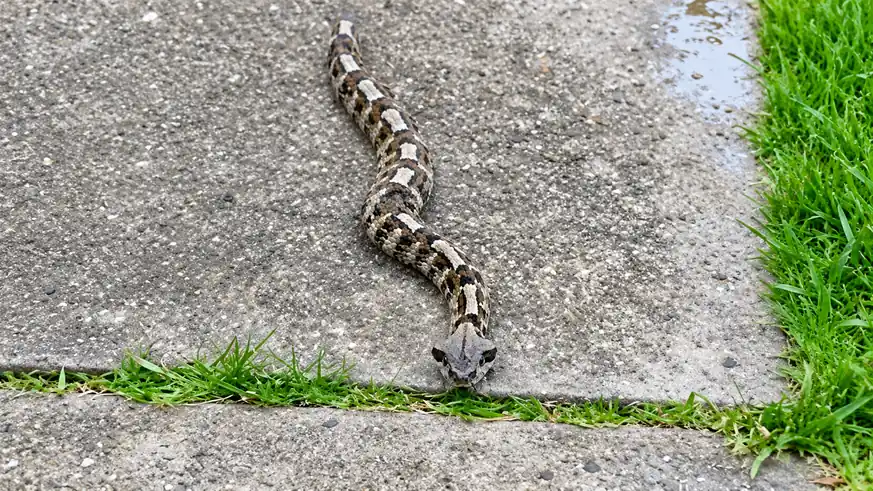
At first, I thought it was a fallen branch or a piece of garden debris near the edge of the lawn, where the grass met the shrubs. Its unusual pattern made it look almost like dried leaves arranged in a strange formation. I felt confused because something about it seemed out of place, although I couldn’t immediately understand why.
I moved one step closer.
Then I froze.
It wasn’t a branch or harmless garden debris. It was a Gaboon viper, lying perfectly still and blending into the ground beneath it. Its natural camouflage made it almost impossible to distinguish from the surrounding leaves and vegetation.
I still consider myself fortunate that I didn’t get any closer. One careless step could have brought me dangerously close to a potentially deadly bite.
The Gaboon viper (Bitis gabonica) is one of Africa’s most remarkable venomous snakes and the heaviest venomous snake in the world. Unlike animals that chase or openly confront threats, this species depends on remaining hidden. Its greatest advantage is its extraordinary ability to disappear into its surroundings.
Its body patterns closely resemble fallen leaves and the textures of a forest floor. Even someone looking carefully may struggle to recognize the snake when it is resting among natural debris. Standing in my yard, I realized how easily I could have mistaken it for something completely harmless.
Where Gaboon Vipers Live
Gaboon vipers are native to the rainforests and savannah regions of sub-Saharan Africa. They are found in countries including Gabon, Cameroon, Nigeria, and the Democratic Republic of Congo.
These snakes prefer environments with plenty of vegetation, fallen leaves, and natural cover. Rather than moving around in search of attention, they often remain hidden, relying on their camouflage to avoid detection.
Their ability to stay unnoticed is an important part of their survival.
A Snake With an Extraordinary Size
One of the most remarkable features of the Gaboon viper is its impressive size.
Adult specimens can grow to around two meters in length and weigh as much as eight kilograms. Their thick bodies make them among the most heavily built venomous snakes.
Despite their powerful appearance, they often remain motionless for long periods. Their stillness can make them particularly difficult to notice when they are resting among leaves or vegetation.
Their fangs are equally remarkable. They can reach approximately five centimeters in length, making them the longest fangs of any venomous snake. These large fangs allow the snake to deliver venom deep into its prey during a strike.
Understanding Its Powerful Venom
The Gaboon viper’s venom is another reason the species deserves caution.
Its venom contains substances that can damage tissue and interfere with normal blood clotting. A bite can cause severe medical complications and may become life-threatening without prompt treatment.
Anyone bitten by a Gaboon viper needs immediate emergency medical attention. Medical professionals can assess the injury and determine whether antivenom and other treatment are required.
Despite its dangerous venom, the snake does not normally seek out humans or deliberately pursue them.
Gaboon vipers are generally described as relatively calm and reluctant to move. Their usual defense is to remain hidden, striking when they feel threatened or are accidentally stepped on.
That was what surprised me most about the encounter in my yard. Such a dangerous animal could remain completely motionless, depending on camouflage rather than aggressive behavior.
A Patient and Efficient Hunter
The Gaboon viper’s hunting technique is just as remarkable as its appearance.
It is an ambush predator, often remaining in one position for extended periods while waiting for suitable prey to approach.
Its diet includes animals such as rodents, birds, and amphibians. When prey comes within striking distance, the snake can attack with impressive speed and precision.
Heat-sensitive pits help it detect warm-blooded animals, even when visibility is limited by darkness or dense vegetation.
Although it does not need to hunt constantly, the Gaboon viper is an efficient predator. A successful meal can provide enough energy to sustain it for an extended period, allowing it to remain hidden and conserve energy.
Why Encounters With Humans Can Be Dangerous
As I stood in my yard, I began to understand why encounters with Gaboon vipers can be so dangerous.
These snakes generally do not search for human contact. Instead, they rely on their ability to remain unnoticed. Problems arise when someone unknowingly approaches one or accidentally steps too close.
I carefully backed away without making sudden movements, keeping my eyes on the exact spot where I had first noticed the snake.
It hadn’t moved.
Somehow, that stillness made the encounter even more unsettling. The snake didn’t need to move to remain dangerous.
Remarkable Senses and Survival Abilities
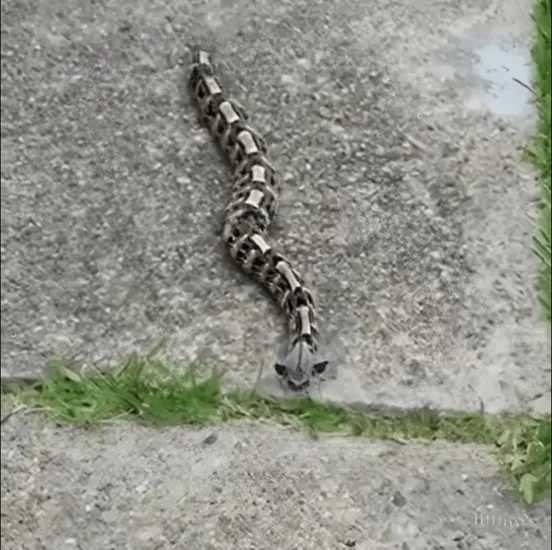
Gaboon vipers also possess impressive sensory abilities that help them survive in their natural environments.
They can detect vibrations through the ground and use heat-sensitive organs to recognize warm-blooded prey. Their senses work together with their camouflage, allowing them to remain effective hunters even when visibility is poor.
Their survival strategy depends on patience, concealment, and precise movement.
Everything about their behavior helps them remain unnoticed until the right moment.
The Important Role Gaboon Vipers Play in Nature
Although Gaboon vipers are feared because of their size and venom, they also have an important place in their ecosystems.
By feeding on rodents and other small animals, they help regulate wildlife populations and maintain ecological balance.
Rodent control can also benefit agricultural environments by reducing damage to crops.
Even a snake that people understandably fear plays a valuable role in the natural world.
A Morning I Will Never Forget
Looking back, I realize how easily nature can hide danger within an ordinary-looking environment.
What initially appeared to be a harmless object in my yard was actually one of Africa’s most specialized ambush predators.
After that experience, I became much more aware of my surroundings. I learned that dangerous wildlife does not always make its presence obvious. Sometimes, the greatest danger is something that remains completely still and almost impossible to see.
The Gaboon viper had not chased me or shown any obvious aggression. It had simply remained hidden.
And that morning, I was fortunate enough to notice it before getting any closer.