
As rescuers removed the towing harness, a stranded whale was finally free to return to deeper waters. At around 5 a.m. on Wednesday, the enormous animal swam away, escorted by rescuers as the first light of dawn appeared.
News of the whale’s desperate situation began spreading across Chinese social media on Tuesday morning. One post announced, “A whale is stranded ashore in the waters of Xiangshan County, Ningbo City, Zhejiang Province!” Concerned users quickly shared the news, drawing widespread attention to the rescue effort.
Located along the East China Sea, Xiangshan is home to many fishermen, including older residents who have witnessed countless things at sea. Yet even they were astonished by the sight of the enormous whale, which measured approximately 20 meters long and lay stranded on the sandy beach.

According to an initial assessment by rescue experts, the animal was a sperm whale weighing an estimated 70 tonnes or more. Local fishery administration staff arrived promptly with a rescue vessel and prepared to tow the whale into deeper water. However, their first attempts to move the giant animal were unsuccessful.
Wang Liangliang, head of the Ningbo Yuren Aquatic Wildlife Rescue Center, led a team consisting of two veterinarians and three divers to the location. The team traveled more than 100 kilometers to reach Xiangshan and help the stranded whale.
“The whale was not badly injured, because the beach was flat with few stones. So, we simply debrided and disinfected it,” Wang explained.

By around midday, the tide had receded, leaving the whale’s entire body exposed on the beach. Although the sun was not particularly intense, the animal faced serious risks. Its skin could lose moisture, and the enormous weight of its body could potentially damage its internal organs.
The whale occasionally moved its tail as rescuers worked nearby, but it was visibly becoming weaker.
Determined to give the animal every possible chance of survival, the rescue team decided to keep it cool and moist while it remained in place. They would wait for the tide to return before making another attempt to move it.
Red buckets were brought to the beach in batches, and rescuers carefully poured seawater over the whale to prevent its skin from drying out. Someone suggested using motorized pumps, but the idea was eventually abandoned because the soft beach mud could not safely support heavy machinery.
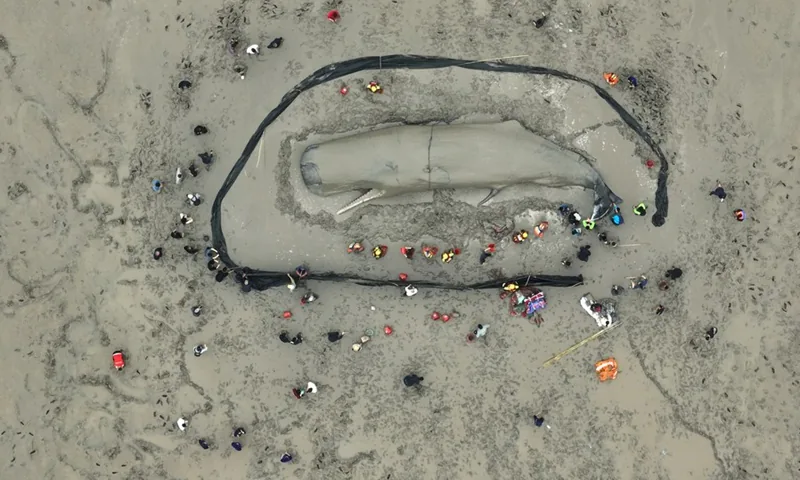
Throughout the afternoon, rescuers continued their exhausting routine of collecting seawater and pouring it over the whale. They were racing against time while waiting for the tide to rise, and the worry was evident on their faces.
Journalists at the scene began broadcasting live updates, while millions of people online watched anxiously and hoped the rescue would succeed.
“Come on, big fish! You’ve got to get through this,” one viewer wrote beneath the livestream.
As darkness settled over the beach, the seawater finally began rising. Rescuers attached a rope to the whale, preparing to tow it away once the water reached a sufficient depth.
“It was gratifying that its health status was gradually improving,” said Zhai Hongchang, a senior engineer with China’s Ministry of Natural Resources who was among the experts involved in the rescue.

By 10 p.m., the tide had risen enough to cover the whale’s body. The rescuers boarded the vessel and began towing the animal toward deeper waters.
The whale cooperated, swimming slowly alongside the boat. Occasionally, it moved its tail as the journey continued, creating a moving sight for the people who had worked tirelessly to save it.
The rescue team carefully selected a suitable location for releasing the whale, hoping to prevent it from becoming stranded again.
“The place must be deep enough, far from the shore, and have plenty of room for maneuver,” Zhai explained. He said the team selected an area approximately 20 nautical miles from the original stranding site.
“There are not many successful cases of rescuing stranded giant whales globally,” Zhai added.
The long rescue operation left the engineer exhausted after he went an entire night without sleep. However, the effort had been worthwhile.
“The moment I saw the whale dive, it was all worth it,” he said.